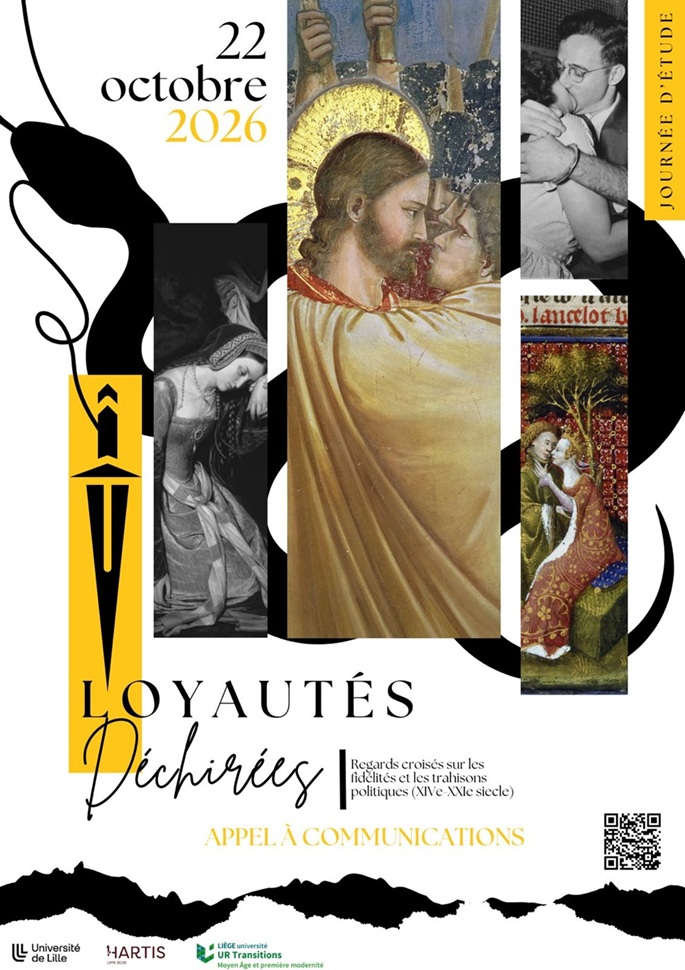
This study day proposes to examine, from a diachronic and interdisciplinary perspective, the multiple forms taken by loyalty and betrayal from the fourteenth to the twenty-first century. From feudal loyalty grounded in oaths to the conflicts of allegiance characteristic of modern and contemporary states, the aim is to analyse how historical actors (princes, subjects, soldiers, clergy, spouses, and citizens) have negotiated, justified, or endured this constitutive tension of the political sphere.
Historically, loyalty appears as a conditional relationship embedded in systems of reciprocal obligations between individuals and institutions. Its breach, far from being exclusively a matter of moral deviance, can be interpreted as a form of political contestation, particularly when power exceeds the limits upon which its legitimacy is founded. Conversely, the accusation of betrayal emerges as a central instrument of stigmatisation, exclusion, and delegitimisation, contributing to the construction of the internal enemy and to the delineation of the boundaries of the political community.
By bringing together approaches from history, political science, law, sociology, and philology, this study day seeks to demonstrate that loyalty and betrayal are dynamic categories, revealing transformations in political regimes, forms of authority, and modes of collective belonging. Through the study of discourses, practices, and figures of the traitor or the loyal subject, the objective is to gain a deeper understanding of how these notions structure power relations and political imaginaries over the long term.
This study day forms part of a series of three events organised over three consecutive years, hosted successively in Lille, Liège, and Luxembourg.
Steering Committee :
Mauréna Benteboula, doctorante en histoire médiévale (Université de Lille – HARTIS)
Élodie Lecuppre-Desjardin, professeur des universités (Université de Lille – HARTIS)
Valentin Fontana, doctorant en histoire moderne (Université de Lille – HARTIS)
Louis Fortemps, docteur en histoire contemporaine (Université du Luxembourg – C2DH)
Hervé Leuwers, professeur des universités (Université de Lille – HARTIS)
Fabio Ventorino, doctorant en histoire médiévale (Université de Liège – Transition)